
Ultimate Urbex Guide for Belgium: Best Abandoned Places 2026
Ultimate Urbex Guide for Belgium: Best Abandoned Places 2026
Belgium has become one of Europe's most exciting urban exploration destinations. With a rich industrial heritage, countless abandoned hospitals, decaying castles, and forgotten coal mines, the country offers some of the most atmospheric exploration opportunities on the continent.
Why Belgium is Perfect for Urbex
Belgium's story is one of industrial decline and rapid change. The country was once a powerhouse of manufacturing, mining, and heavy industry. From the 1980s onward, factories closed, coal mines were abandoned, and entire regions fell into decay. This left behind a treasure trove of forgotten spaces—hospitals, psychiatric asylums, military installations, and sprawling industrial complexes.
The Walloon region in southern Belgium was the epicenter of coal mining, with deep shafts dating back to the 19th century. When coal became economically unviable in the 1970s and 1980s, entire communities were left behind. Liege, once thriving, now features dozens of abandoned factories.
Flanders, in the north, has similar industrial heritage but with maritime elements—abandoned shipyards, warehouses, and dock facilities.
Legal Considerations in Belgium
Before exploring, understand Belgian law. Belgium takes property rights seriously. Trespassing on private property can result in fines (€100–€5,000+), criminal charges, civil lawsuits, and jail time for repeat offenders.
The Golden Rule: If not 100% certain you have permission, do not enter. Many sites are privately owned and owners will prosecute.
Legal alternatives exist: Some sites offer organized tours, heritage days allow public access, and some owners grant permission if asked respectfully.
Top 15 Abandoned Places in Belgium
1. Château de Logne
Location: Logne, Wallonia | Type: Medieval Castle | Accessibility: Medium | Safety: 3/5
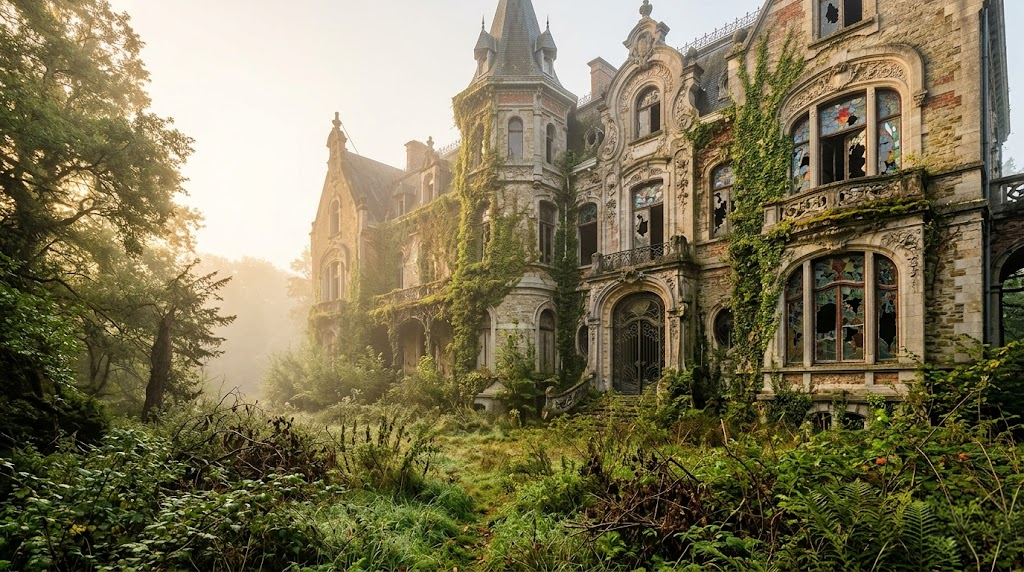
This stunning 12th-century castle sits in romantic decay. Stone walls crumble, ivy covers facades, and the interior is frozen in time. The main tower remains mostly intact, offering views across the countryside. Built as a grand estate but fell into disrepair after the owners passed away.
Hazards: Unstable stonework, falling debris, uneven floors.
2. Kautbersort Military Complex
Location: Near Spa, Eastern Belgium | Type: Military Installation | Accessibility: Hard | Safety: 2/5
A sprawling Cold War NATO base. The complex includes barracks, command centers, ammunition storage, and underground bunkers. Many sections remain sealed, but explorers have documented eerie abandoned offices, sleeping quarters with personal belongings, and cryptic military signage. The surrounding forest is reclaiming the structures.
Hazards: Asbestos in 1950s-1970s buildings, unstable roofs, flooded basements, military contamination.
3. Psychiatric Hospital Complex, Ghent
Location: Outskirts of Ghent, Flanders | Type: Hospital | Accessibility: Medium-Hard | Safety: 2/5
Massive early-1900s psychiatric facility spanning dozens of acres. Multiple buildings—wards, operating theaters, staff quarters, kitchens. Patient records and medical equipment remain in some sections. The architecture reflects early 20th-century asylum design: long corridors, high ceilings, barred windows.
Hazards: Asbestos tiles, biological contamination, unstable flooring, sharp medical instruments.
4. Charleroi Industrial Zone Factories
Location: Charleroi, Wallonia | Type: Steel & Chemical Factories | Accessibility: Hard | Safety: 2/5
Heartland of Belgian heavy industry. Massive steel factories, chemical plants, and foundries sit silent and decaying. Blast furnaces, conveyor systems, worker facilities—all abandoned. Some structures are 100+ years old, representing different industrial eras. The scale is breathtaking.
Hazards: Extremely unstable structures, chemical residue, flooded areas, sharp metal debris, toxic materials.
5. Liege Coal Mines
Location: Liege, Wallonia | Type: Coal Mine | Accessibility: Hard | Safety: 1/5 ⚠️
Belgium's legendary coal mining heritage. Multiple mines with shafts extending hundreds of meters underground. Surface structures—mining buildings, bathhouses, machinery, railways—remain. The scale and industrial aesthetic is remarkable.
⚠️ EXTREME HAZARD: Coal mines are EXTREMELY DANGEROUS. Shafts collapse, underground flooding is common, air quality is poor. Many shafts are sealed for good reason. Only explore with professional guides.
Regional Breakdown
Wallonia (Southern Belgium)
Character: Industrial heartland | Best for: Coal mines, steel factories | Difficulty: Hard
Wallonia is where Belgium's industrial story is most evident. Coal mining shaped the region for 200 years. When mines closed in the 1970s, communities struggled but left incredible urbex sites.
Flanders (Northern Belgium)
Character: Maritime + Industrial | Best for: Shipyards, warehouses, textile mills | Difficulty: Medium
Flanders has different industrial heritage—shipping, textiles, and commerce. Port cities like Antwerp have sprawling abandoned warehouses and dock facilities.
Brussels-Capital
Character: Urban decay | Best for: Apartment blocks, office buildings | Difficulty: Medium
Brussels offers unique urban exploration—abandoned social housing, forgotten commercial buildings, underground structures, Cold War bunkers.
Safety Hazards Specific to Belgium
Coal Mine Shafts
Belgium's mining heritage means numerous mine shafts throughout Wallonia. EXTREMELY DANGEROUS. Shafts collapse, underground flooding is common, poor air quality. Never explore alone.
Asbestos in 1950s-1970s Buildings
Most hospitals, military buildings, and industrial facilities contain asbestos. Causes mesothelioma and lung cancer. Always wear proper respirator.
Flooded Basements & Groundwater
Belgium's water table is high. Many basements are partially or completely flooded. May contain contaminated water or chemicals. Never wade into standing water.
Industrial Chemical Residue
Steel plants, chemical factories, pharmaceutical facilities leave chemical residue. Never touch or disturb anything unknown.
Best Time to Visit Belgium
Spring (April-May): Mild weather, long daylight, good for photography.
Summer (June-August): Warmest but tourist season.
Autumn (September-October): Cool, dry, beautiful colors, fewer tourists. BEST SEASON.
Winter (November-March): Cold, wet, dark, short days.
Getting Around & Accommodation
Belgium has excellent infrastructure. Train system (SNCB) connects all major cities. Car rental affordable. Hotels/hostels everywhere.
Urbex hubs: Liege (2 hrs from Amsterdam), Charleroi (1 hr from Brussels), Ghent (30 min from Antwerp), Brussels (capital).
Community & Resources
Belgian urbex community exists on Reddit, Discord, and Facebook groups. Experienced explorers share information and organize group explorations.
Ethical Exploration
Respect Belgian property rights. Don't damage anything. Leave no trace. Document responsibly—some locations shouldn't be publicized. Preserve what you find for future explorers.
Conclusion
Belgium offers world-class urban exploration. From medieval castles to industrial wastelands, the country is a treasure trove. Approach with respect, prepare carefully, prioritize safety.
Ready to explore? Browse verified Belgian locations to find specific sites with GPS coordinates. Or explore premium map bundles for complete Belgium coverage.