
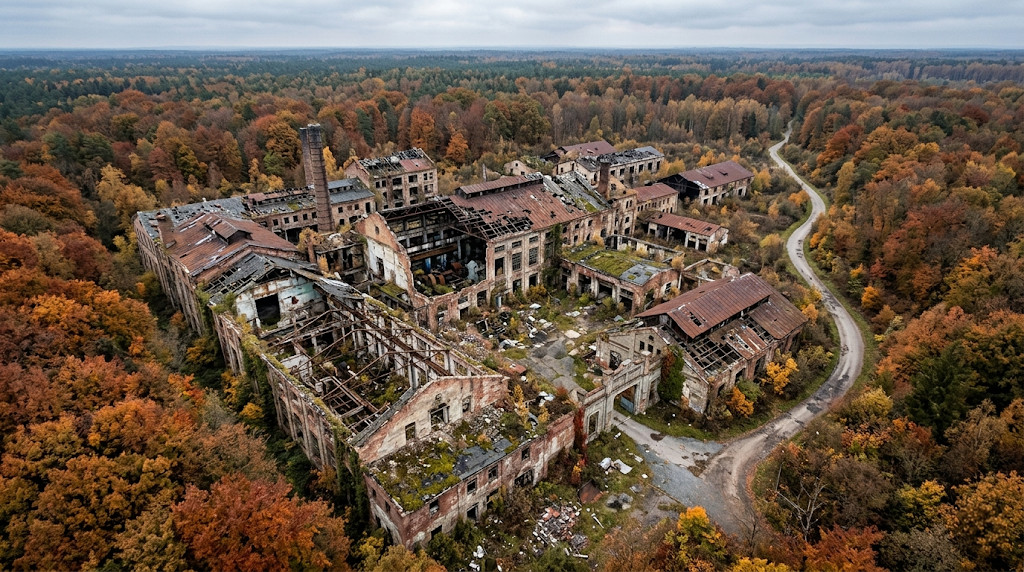
How to Find Abandoned Places in Europe: The Ultimate 2026 Guide
Europe is home to thousands of abandoned buildings — from crumbling chateaux in the French countryside to Soviet-era military bases in eastern Germany, forgotten asylums in Belgium, and time-capsule villas scattered across Italy. But finding these locations isn't always straightforward.
At UrbexVault, we've catalogued over 7,200 abandoned locations across 67 countries, with nearly 40,000 registered explorers and 1,400+ community-uploaded photos. Based on years of experience from our community, here's a complete guide to finding abandoned places in Europe — whether you're a first-timer or a seasoned explorer looking for new spots.
1. Use Satellite and Aerial Imagery
Before you ever set foot near an abandoned building, your most powerful tool is sitting on your desk. Google Maps, Google Earth, and Bing Maps let you scan entire regions from above.
What to look for in satellite view:
- Collapsed or missing roof sections — a clear sign of long-term abandonment
- Overgrown driveways, car parks, and surrounding areas
- Buildings with no vehicles or signs of activity
- Industrial complexes near railway lines or waterways that appear disused
Pro tip: Bing Maps offers a "Bird's Eye View" — a 45-degree angled aerial perspective that reveals structural details you'll miss from straight-down satellite shots. Damaged walls, broken windows, and vegetation growing through roofs become much more visible.
Google Earth Pro (free) also lets you use the historical imagery slider to see how a building has changed over time. A factory buzzing with trucks in 2010 but empty and overgrown in 2025? That's your lead.
2. Follow the Railways and Waterways
Europe's industrial history is written along its transport routes. Before highways, factories, mills, breweries, and warehouses were built along railways and canals — that's how they moved raw materials and finished goods.
Many of these industries have closed, but the buildings remain. On UrbexVault, some of our most popular categories include factories, mills, breweries, barracks, and industrial buildings — and a disproportionate number sit within a few hundred metres of old rail lines.
Practical approach: Open Google Maps, trace a rail line through a rural or semi-industrial area, and scan for large structures with empty car parks. Switch to Street View and drive virtually past them. You'll spot boarded-up windows, "For Sale" signs from years ago, and overgrown access roads.
3. Compare Historical Maps with Modern Imagery
One of the most effective — and underused — techniques is comparing old maps with current satellite imagery. Buildings that were active 50 years ago may now be abandoned or even partially demolished.
- Geoportail (France) lets you overlay 1950s-era maps over current imagery, revealing vanished factories and industrial complexes
- Old Maps Online aggregates historical maps from archives worldwide
- Google Earth Pro has a timeline slider for comparing imagery from different years
This technique is particularly effective in countries with heavy post-war industrial decline, like Belgium, northern France, and the Ruhr region of Germany.
4. Drive and Explore in Person
There's no substitute for getting in your car and driving through areas with potential. Many abandoned buildings hide in plain sight — you just need to be actively looking.
Where to focus your drives:
- Rural villages — particularly in regions with declining populations (parts of France, Italy, Spain, and eastern Europe)
- Edges of towns — where old industrial estates sit half-empty
- Near former military bases — especially in Germany, Poland, and the Baltics where Soviet-era installations were abandoned after 1991
Talk to locals when you can. Older residents often know about the closed school, the abandoned farm up the road, or the factory that shut down twenty years ago. Local knowledge is one of the most reliable ways to find places that don't appear on any database.
5. The Best Countries for Urbex in Europe
Not all European countries offer the same urbex opportunities. Based on data from our community, here's where you'll find the most locations:
Belgium — The World's Urbex Capital
Belgium has more abandoned locations per square kilometre than arguably anywhere else on Earth. On UrbexVault alone, we list 1,348 locations in Belgium — from fully furnished chateaux to disused coal mines and art deco swimming pools. The combination of old industry, aristocratic estates, and relatively relaxed enforcement has made Belgium the go-to destination for European urbex.
France — Endless Variety
France leads our database with 2,177 locations, ranging from abandoned chateaux and manor houses in the countryside to industrial complexes in the north. The sheer size of the country means there are still locations being discovered regularly.
Italy — Architectural Treasures
With 861 locations on UrbexVault, Italy offers some of the most photogenic abandoned places in Europe. Crumbling villas with frescoed ceilings, abandoned churches, and ghost villages evacuated after earthquakes or landslides — Italy is a photographer's dream.
Germany — Industrial Heritage
Germany's 714 catalogued locations include massive industrial complexes, Soviet military installations, and abandoned sanitariums. The former East Germany is particularly rich in locations, though German trespassing laws are among the strictest in Europe.
Other Standout Countries
- United Kingdom — 478 locations, strong community culture, more lenient trespass laws
- Netherlands — 451 locations, with a dense network of sites given the small country size
- Poland — 95 locations and growing, known for abandoned palaces and hospitals
- Czechia — 72 locations, including atmospheric castles and industrial ruins
6. Use Online Databases and Community Platforms
The urbex community has built several platforms to help explorers find locations. Here are the most useful:
- UrbexVault — The largest platform with 7,200+ locations across 67 countries, community photos, reviews, and GPS coordinates. Features maps, location bundles, and a community of nearly 40,000 explorers.
- 28DaysLater.co.uk — One of the oldest urbex forums with detailed exploration reports
- Reddit r/Urbex — Active community where information flows through DMs (not public posts)
- Discord servers — Many urbex YouTubers run private servers with verified member systems to share coordinates responsibly
Why Coordinates Aren't Shared Publicly
If you're new to urbex, you might wonder why people don't just post exact addresses. The reason is protection: publicly sharing a location's address exposes it to vandalism, theft, and destruction. The urbex community operates on trust — you earn access to coordinates by demonstrating you respect the locations.
This is why platforms like UrbexVault exist: they provide verified coordinates to serious explorers while helping protect locations from casual destruction.
7. Safety: What You Need to Know
Finding locations is only half the equation. Exploring them safely is just as important.
Never Explore Alone
This is the single most important rule. Always bring at least one other person. The experienced approach is the "one after another" method: one person enters a room or climbs a staircase first, while the other waits. If something goes wrong — a floor collapses, a staircase gives way — the second person can call for help.
Always tell someone outside your group where you're going and when you expect to be back.
Asbestos is the Hidden Killer
Any building constructed before the 1990s in Europe may contain asbestos in insulation, floor tiles, roof panels, or pipe lagging. When disturbed, asbestos releases microscopic fibres that cause serious lung disease and cancer.
You need a P100 respirator — not a dust mask, not an N95. P100 filters are the only ones rated for asbestos fibres. This isn't optional: it's the single most important piece of gear you'll carry.
Essential Gear Checklist
- P100 respirator mask
- Powerful flashlight or headlamp with spare batteries
- Sturdy boots with ankle support and thick soles
- Puncture-resistant gloves
- First-aid kit
- Fully charged phone
- Long sleeves and trousers (protection against cuts and dust)
Structural Awareness
Test floors before putting your full weight on them, especially on upper levels. Avoid basements and roofs where water damage is worst. Watch for rotted wood, rusted metal supports, and crumbling concrete. If something doesn't feel right, back out — there are always other locations to explore.
8. Legal Considerations Across Europe
Urbex sits in a legal grey area in most European countries. Understanding the laws where you explore is essential.
- UK & Ireland — Trespass is mainly a civil matter. You won't typically be arrested just for entering an abandoned building, though you can be asked to leave.
- Germany — Hausfriedensbruch (trespass) under Section 123 of the Criminal Code carries up to 1 year imprisonment or a fine. Germany has the strictest enforcement in Europe.
- France — Even "abandoned" property may legally be someone's domicile. Entering without permission can be criminal if boundaries or signs are violated.
- Czechia — Up to 2 years imprisonment for simple trespass.
Universal rules that apply everywhere:
- Never break anything to gain entry — forced entry is criminal activity in every European country
- Don't take anything — "take only pictures, leave only footprints" is the golden rule
- If confronted by police or owners, comply immediately and leave
- Respect "No Entry" and "Private Property" signs
Start Exploring
Finding abandoned places in Europe is a mix of digital detective work, real-world scouting, and community connections. Start with satellite imagery to identify potential locations, use historical maps to find hidden gems, and join the community to learn from experienced explorers.
Ready to find your first location? Browse UrbexVault's free map to see abandoned locations near you, or explore our full database of 7,200+ locations across Europe and beyond.